Monday, August 9, 2010

A visit to the Schwetzingen palace gardens


In early summer I visited the Schwetzingen palace gardens with an old friend. It's one of those places that's so close by that I don't seem to get around to going there much. But I should! What a fabulous place. There are many great websites (also here, and here is a very good brochure in English) on these gardens if you're interested. In this post I'll concentrate on the incredible tree-lined avenues in the park.

Although the gardens include many highlights such as a large formal French-style garden, English-style landscaping, a mosque, temples to various Greek gods, lakes, fountains, an orangery, and of course the palace, it was the trees that struck me most this time. Almost anywhere you look there are axes of perfectly symmetrically trimmed trees offering astonishing perspectives on the many sights (click to enlarge any photo).

Here's another view of the same ensemble.
When the palace and garden were originally built in the 18th century, at the same time a tree-lined boulevard was built from Schwetzingen castle to Heidelberg. It was lined with mulberry trees in the hopes of encouraging the silk industry! Not much is left of the six-mile avenue or the mulberry trees, but within the palace grounds there are still plenty of avenues. This one reminds me of an aqueduct.


In the photos below, the formally-pruned "hedge" of trees forms the border between the baroque French garden and the more English-style landscaped garden beyond it.

Some more impressions:
And just so you don't get the impression there are no flowers in these gardens:
And to close, here's a shot of one of the parrots that have invaded many of the area's parks, also in Mannheim. They survive the winters here and apparently are originally from South Asia. I believe the correct name is Alexandrine Ringneck Parakeet. Some people have come to regard them as an invasive pest, as they drive native birds away from feeding places. But it's always astonishing to encounter one. (Better click to enlarge this one.)
I highly recommend a visit if you're ever in southern Germany. Schwetzingen is very close to both Mannheim and Heidelberg.

Friday, July 30, 2010

Zillions of zucchinis (with recipes)

First off I want to apologize to any readers I may have for my long absence. Things were topsy-turvy for a while, but I'm finally writing a blog post again.

Now that it's midsummer I'm starting to harvest vegetables, including up till now onions, garlic, and herbs, but above all right now: zucchinis. I tried to solve the space problem by raising my own from seeds which promised "climbing zucchinis", i.e. that could be fastened to poles like tomatoes. Well, they did produce a longish main stem which I tied to poles, but also produced huge lateral branches that take up just as much room as conventional zucchinis. The two plants I have seem to bear twice as much fruit as normal zucchinis! Here are some impressions of how they're now dominating my hedged-in potager (click to enlarge):


Since I harvest up to four zucchinis a day, I've been experimenting with recipes and have come up with a few the family likes. Here are two of our favorites:

Zucchini-vegetable cream soup

Ingredients for four generous servings: 3 medium zucchinis, 1 potato, 1 medium onion, 1 clove garlic, 3 tomatoes, 2 small or 1 large carrot, 50 ml whipping cream, vegetable broth (granules or cubes), hand blender for pureeing.


Peel and chop the potato, carrots, onion, and garlic; chop the zucchini and tomatoes, about like this.


Sauté the onions and garlic for a few minutes in a small amount of butter, then add and briefly sauté the zucchini, carrots and potato.


Add the tomatoes and broth to almost cover the vegetables. I use vegetable stock, but you could also use beef or chicken bouillon. Simmer until tender and puree coarsely. Stir in the whipping cream and season to taste. IMPORTANT: This soup needs lots of freshly ground black pepper.


Serve with freshly chopped herbs, a drizzle of cream and a dusting of freshly ground black pepper. I use a mixture of chopped chives, garlic chives, oregano and rocket.


Zucchinis gratinée

Ingredients for four servings: 4 zucchinis cut in half lengthwise, 2 tomatoes, about 100 g of gouda or parmesan, some day-old baguette, olive oil, salt, freshly ground black pepper. Butter to grease the baking dish.

Grease a baking dish, place the zucchinis in it and drizzle with olive oil. Salt and pepper generously.

Grate the cheese and baguette and mix together (the baguette has to be very dry). Sprinkle mixture over the zucchinis. Slice the tomatoes and distribute on top. Generously salt and pepper the tomatoes and drizzle with olive oil.

Bake for about half an hour in medium oven or until the zucchinis are tender and the topping is slightly browned.
Serve with pasta or rice and tomato sauce.


Guten appetit!

Thursday, April 8, 2010

Pruning the espalier fruit trees

We have the great fortune to have a pruning expert among our acquaintances, and on March 1 he came out to the garden to give us some lessons, especially on pruning the espalier apple and pear trees, and on the roses. It was high time, he said, as the trees were just starting to show the swellings where they would soon bud, but it was still cold enough that the sap was not really flowing yet.

Once they've been trained, in principle there's not much difference between pruning espalier fruit trees and conventional fruit trees. Ours are about 30 years old and have already been well-trained, so they now simply need to be maintained. The trees are so long-established that they also no longer need to be attached to the trellis.

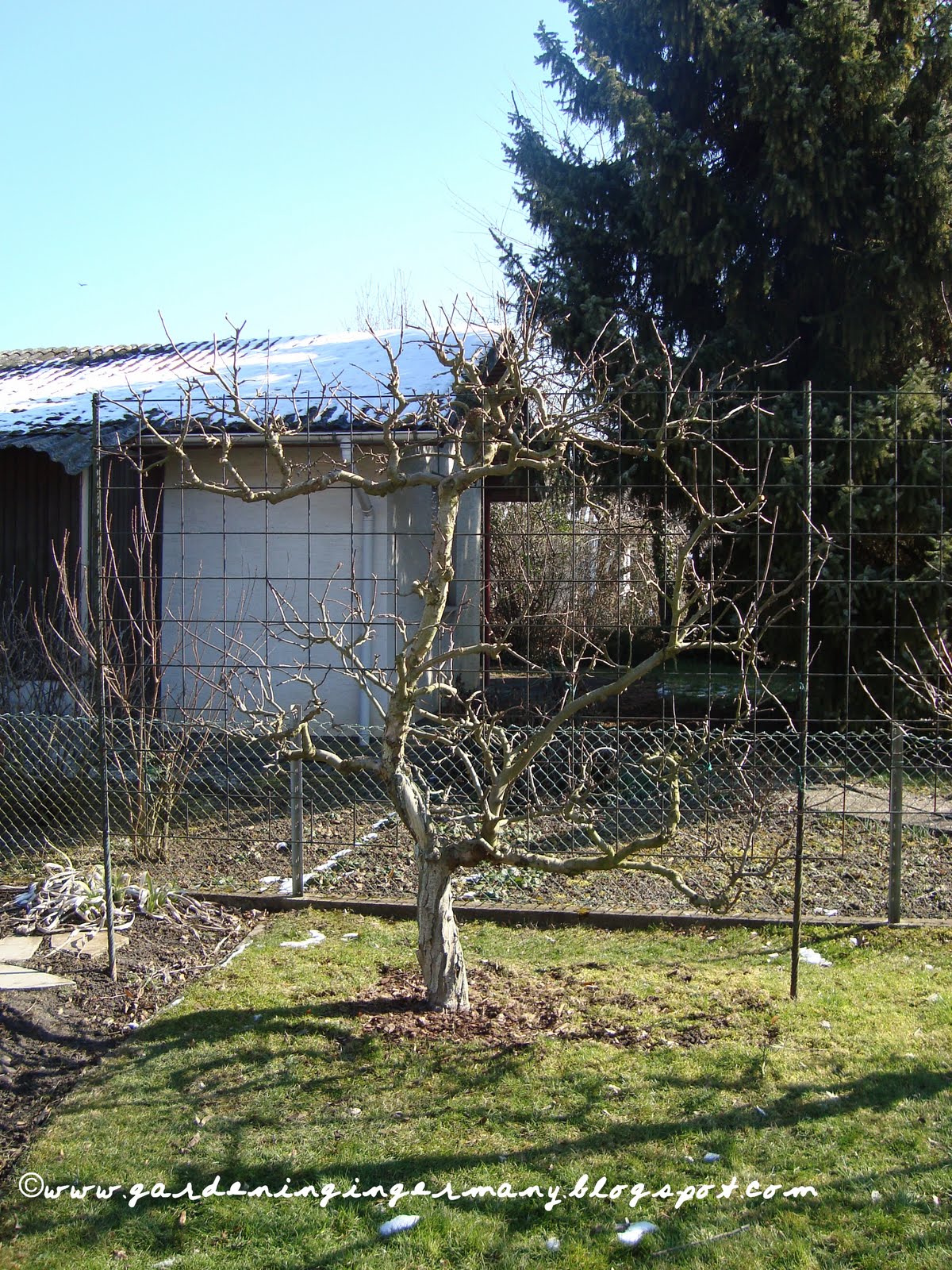
The first principle is maintaining the shape when seen from all sides. This means that when seen from the front, there shouldn't be more than 4 to 5 strong horizontal branches on each side of the trunk. In our case, the trees hadn't been pruned for a while and were already developing additional branches, often protruding to the front or back instead of to the side. They had to go. Click photos to enlarge.


Another thing that had to go were the long vertical shoots along the top of the espaliers that make them look like they have "hair". Here an example of an unpruned "hairy" tree.


Seen from the side, you want to maintain the "flatness" of the row of trees. Keeping this in mind also helps in deciding what to remove.


As with other fruit trees, it's important to thin out twigs that interfere with each other, and to make the cuts just above eyes or branches pointing in the direction that you want the tree to develop in.


Here there are too many twigs:


Here's what it should look like after clean-up:


Here are some examples of finished trees. You can get a feel for how much was cut off if you click to enlarge. I was a little dismayed, but now, a month later, the trees are about to burst into blossom and they look just great. I'll post some photos of when they're in full bloom.